CCA Guide
A quick reference for City Carrier Assistants — the policies, timelines, and day-to-day rules that matter most when you're new. Some of this comes from older guides, and the National Agreement expired May 22, 2026 with the next one still being negotiated, so confirm anything uncertain with your steward.
Probation & Timeline
- CCA probation: 90 workdays (days in pay status) or 120 calendar days, whichever comes first.
Hired on 360-day appointments, with a 5-day break between terms.
The 5-day break does not end a hold-down.
- Discipline from your CCA time is wiped out on conversion — it can't be cited in later discipline decisions. (JCAM 16-13)
New hires stay in their employing office for the first 8 weeks.
Week 1 is the week OJI training starts. If your office has no OJI, you may train elsewhere and then return.
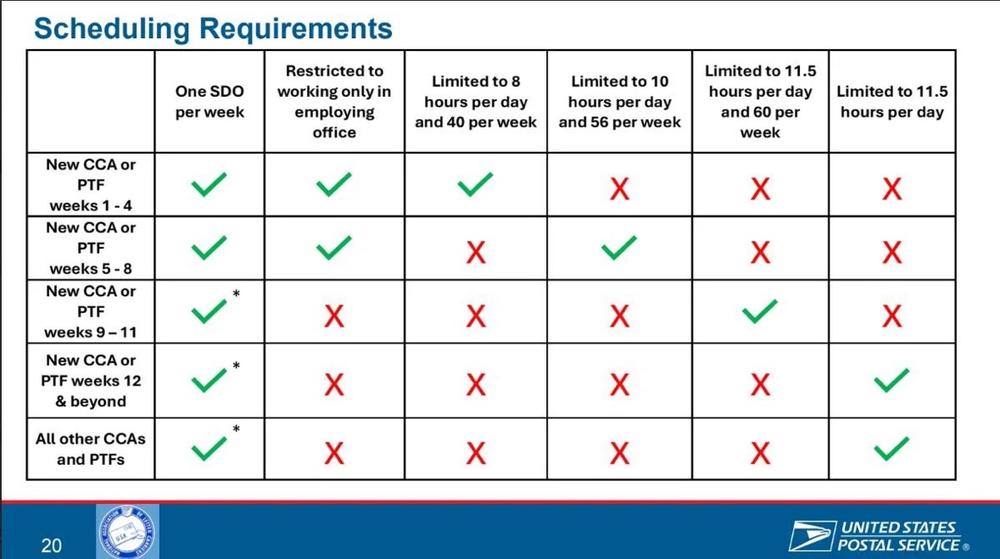
NEERMP workhour limits: weeks 1–4, 8 hours a day and 40 a week; weeks 5–8, 10 a day and 56 a week; from week 9, 11.5 a day.
You're unavailable beyond those hours through week 11.
See more
- No career probation if you successfully served a 360-day appointment and convert during it or directly after the five-day break.
90-day career probation only if you haven't successfully served a 360-day appointment directly before converting.
During probation, management can separate you at any time — except for scheme failure, which requires at least 7 days' advance notice. Qualify on the scheme within that notice period and you won't be separated for that failure.
- A new employee's first day in their employing office after Carrier Academy cannot be a Sunday.
Pay & Benefits
Current CCA hourly rates — effective March 7, 2026. Full NALC pay chart (PDF)
| Step BB | Step AA | |
|---|---|---|
| City Carrier (Grade 2) | $21.21 | $21.71 |
Annual leave: 1 hour per 20 hours in pay status, up to 4 hours per pay period and 13 days a year.
You're advanced 40 hours of annual leave on reappointment. Unused annual leave can't be carried to your next appointment — it's paid out in a lump sum at the end of the 360-day term.
- CCAs have no sick leave — use annual leave when sick.
Holiday pay for 6 holidays a year: New Year's Day, Memorial Day, Independence Day, Labor Day, Thanksgiving, Christmas.
Eligible if you're in pay status the last hour of your scheduled workday before the holiday or the first hour after it. Hours paid depend on office size: 8 hours in 200-workyear offices, 6 hours elsewhere, 4 hours in POStPlan offices. Holiday pay is not a day off — check the posted schedule. Career carriers get 10 paid holidays a year.
If you work a holiday, you can elect annual leave credit instead of holiday pay.
4, 6, or 8 hours, matching your office size. Do it on PS Form 3971, checking the "Holiday/AL Lv Exch" box. Holiday pay is paid in addition to pay for hours actually worked.
All leave goes on PS Form 3971; keep a copy.
Leave requested in advance is pre-scheduled. Last-minute or after-the-fact illness leave counts as unscheduled, and too many unscheduled absences can mean discipline or termination — especially on probation.
FMLA: eligible after 12 months of USPS service and 1,250 actual work hours in the 12 months before the leave.
Breaks don't reset the 12-month clock. Up to 12 workweeks (26 workweeks of military caregiver leave). FMLA is charged to annual leave or LWOP — it adds no paid leave.
Bereavement Leave: up to 3 workdays of annual leave (or LWOP for CCAs) for the death of a family member.
Family member means son or daughter (including stepchild and in-laws), spouse, parent, sibling (including in-laws), grandparent, or grandchild.
Leave Sharing: CCAs can both receive and donate annual leave.
To receive, you must expect to miss at least 40 more hours than your own leave covers. Single donations must be 8 or more whole hours.
Uniform allowance: $549 a year once probation is done, plus a one-time $128 credit for new eligibles.
$536 before May 21, 2026. Management submits via eBuy, and a Letter of Authorization must reach you within 14 days of your eligibility date. Take it to a USPS-authorized vendor; Type 1 items only. Your anniversary date is the date you first become eligible and never changes, even after conversion. If separated without reappointment, return all purchased uniform items.
Health insurance: the USPS Noncareer Health Care Plan is open to all CCAs.
Elect within 60 days of hire, within 60 days after returning from a 5-day break, or during open season. The USPS contribution is the greater of $125 biweekly or the ACA minimum for self-only, and 75% of the premium for self-plus-one or family (since plan year 2022). Coverage continues automatically across the 5-day break.
FEHB: only after an initial 360-day term and reappointment, at full cost to you (no USPS contribution).
Open season runs from the Monday of the second full workweek in November through the Monday of the second full workweek in December.
Retirement saving as a CCA: the NALC CCA Retirement Savings Plan (through the Mutual Benefit Association) — contribute as little as $15 per pay period, or start with a one-time $15 payment and no further deposits required to keep the policy in force.
Funds can transfer to TSP on conversion.
See more
Wounded Warriors Leave: 104 hours per leave year for veterans with a service-connected disability rating of 30% or more.
For medical treatment of that disability. No carryover. Request it on Form 3971 marked "other" with "Wounded Warriors Leave" written in.
- Long stretches of leave without pay delay step increases, stop TSP, life and health contributions, and leave accrual, and can block transfers.
No FEGLI life insurance until career — but every NALC member in good standing (including CCAs) gets a free $5,000 Group Accidental Death Benefit.
NALC's Mutual Benefit Association sells life insurance to members in the meantime. MBA: 202-638-4318 or 800-424-5184, nalc.org/mba.
Check your pay stub after every 5-day break — CCA rates have been wrongly reduced before.
Verify PS Form 50, item 62 ("Base Salary"). If it's wrong, call Shared Services at 877-477-3273 (option 5) and tell your steward.
Your pay stub code is 84-4 for CCAs.
Keep your own hours record (the NALC Work Hour Tracker) to catch pay errors right away. Detailed earnings are usually on LiteBlue's ePayroll by the Tuesday evening before payday.
Time is kept in hundredths of an hour.
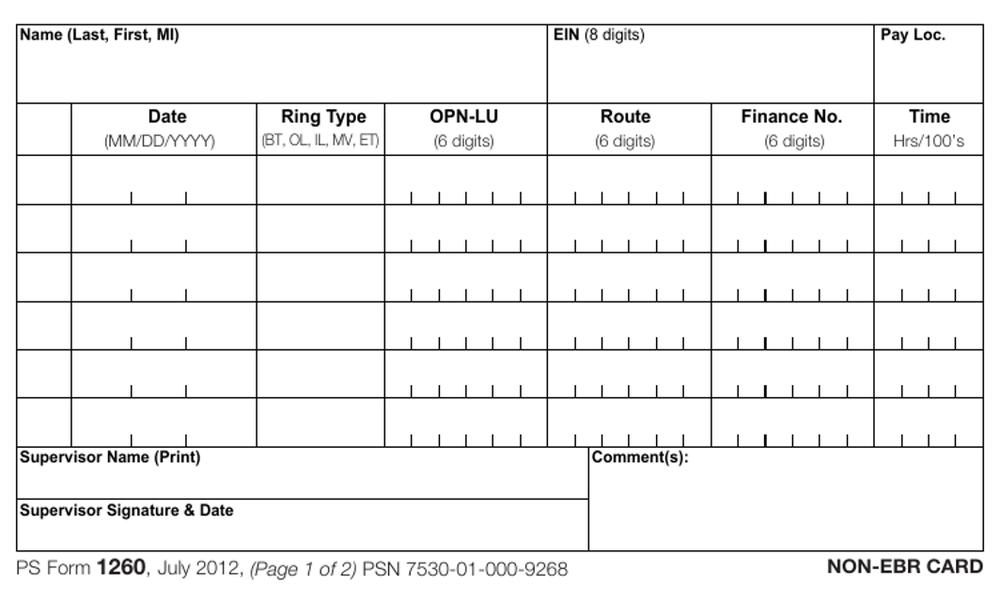
If the badge reader and the MDD app are both unavailable, use PS Form 1260 — and only then. You can check your clock rings any day on LiteBlue's Virtual Timecard.
Night shift differential: extra pay for time worked 6 p.m.–6 a.m.
Check the current rate with your steward.
Scheduling & Work Rules
- Work-hour guarantee when scheduled and you report: 4 hours at 200+ workyear offices, 2 hours elsewhere.
Hard cap: 12 consecutive hours of total service in a day, including lunch and breaks — effectively 11.5 hours of work.
Report at 6 AM and you're off by 6 PM. This applies even in December.
Overtime: 1.5× over 8 hours a day or 40 a week; 2× (penalty) over 10 hours a day or 56 a week.
No penalty overtime in December, and no pyramiding — daily or weekly penalty, not both.
Hours beyond 12 in a service day or 60 in a service week pay 2.5× the base hourly rate.
This one applies even in December.
- The service week runs Saturday 12:01 AM through Friday midnight.
- CCA schedules must be posted by close of business Wednesday of the preceding week.
Your schedule changes day to day unless you're on a hold-down.
Check the posted schedule for your reporting time and assignment each day.
Your non-scheduled day can be moved to a later day in the week with proper notice.
That should be the exception, not routine.
No standby: CCAs can't be required to call in or wait at home for a call on days they're not scheduled.
Tell the steward if management tries it.
- Split shifts: return within 2 hours, no new guarantee; return after 2 hours, a new 2- or 4-hour guarantee applies.
Lunch is 30 minutes, unpaid, and you must take it.
Working through lunch is working off the clock, which the contract forbids. After 6 continuous hours a half-hour is deducted automatically. You can request your lunch after 6 hours of work.
Authorized lunch locations are on PS Form 1564-A in the route book.
Check it before you leave for the route.
Two paid 10-minute breaks per 8-hour day, separate from each other and from lunch. (Branch 1595: two 15-minute paid breaks instead.)
Reasonable comfort stops don't count against your time.
- CCAs work Sunday parcel delivery.
Hold-downs (opting): eligible after 60 calendar days from appointment.
No additional waiting period on reappointment. Any temporarily vacant full-time assignment lasting 5 or more days is open to opt. Submit a written request to the supervisor who oversees the assignment and keep a copy. It goes to the eligible CCA with the highest relative standing who asked and isn't already on another opt.
- How opting is announced varies by office — ask your steward how this office does it.
A hold-down lasts until the regular returns, even mid-week.
You can reclaim it after your own vacation.
A hold-down ends when the regular returns, even if only to do part of the duties.
For example, to case but not carry. Your 5-day break between 360-day terms does not end an opt. You can bid for a permanent full-time assignment during a hold-down and must be reassigned to it.
You can be "bumped" off a hold-down to give a PTF 40 hours of straight time or a full-timer 8 hours.
Only as a last resort, and the opt isn't terminated; you're just off it day-to-day.
Pay on a hold-down: you keep CCA pay — you don't assume the regular's pay status.
A hold-down does NOT guarantee 8 hours a day, 40 hours a week, or your days off.
Once a CCA or PTF hits their work-hour limits, they're unavailable.
They can't be worked beyond the limits to give auxiliary assistance to a regular not on the overtime or work-assignment lists.
On the Route
Morning routine: listen for open routes, check mail volume (DPS, walk sequence), note safety items, and check your vehicle.
Safety items include weather, driving, and accidents. Vehicle check: does it start, any flat tire?
Do the expanded vehicle safety check every day.
Catch maintenance failures (including vehicle fires) before you leave.
- Vehicle rules, every time: seatbelt on, never drive with the door open, set the parking brake, curb your wheels, take the keys when you dismount, report accidents immediately.
You can't be coerced into using your personal vehicle — CCAs can't enter Drive-Out agreements.
You may volunteer if the postmaster or station manager determines it's necessary for business, but only through PS Form 8048 (Commercial Emergency Vehicle Hire). Don't use your own vehicle for work without one.
Mileage: if you're sent to another work unit beyond your normal commute, USPS reimburses mileage above the home-to-duty-station distance.
Plus tolls and parking via eTravel.
Temporary assignments to another post office are within a 50-mile radius of your permanent duty station, on an occasional basis.
Volunteers go first; if there aren't enough, CCAs are assigned in reverse relative standing order.
There's no minimum street pace you must maintain. Work at a pace your body can sustain for a whole career.
If you can't finish in 8 hours, report it as soon as you know and file PS Form 3996.
- Take all your breaks and comfort stops.
Sanctity of the mail is absolute: never delay, obstruct, or mistreat mail, and don't take shortcuts under time pressure.
It can mean discipline or removal, and federal statutes apply. If you need more time, file a 3996.
New routes are hard and that's normal: unfamiliar addresses, mailbox locations, dogs, mail for people who moved months ago.
Ask the other carriers — they were all new once.
NEERMP (began July 1, 2025): the joint NALC/USPS program gives new carriers a more moderate learning pace, mentoring, and continuing education beyond Carrier Academy and OJI.
With better communication with managers and coworkers.
- Be kind to customers, and you're not alone — the bond with the carriers on your workroom floor matters most.
Your Rights
- Talk to your shop steward FIRST about any issue; branch officers are the backup.
Obey instructions — except ones that would cause imminent danger to life or limb or violate the law.
If you think an order violates your rights, carry it out, then tell your steward immediately so it can be investigated and grieved if appropriate. You can also file a written protest.
- Keep a copy of every form you submit (3971, 3996, and the rest).
Grievances must be filed within 14 days of the violation.
The ladder: Informal Step A (discuss it with your immediate supervisor; you may bring a union rep) → Formal Step A → Step B (a Dispute Resolution Team: one NALC rep and one USPS rep) → Arbitration (final and binding).
No grievance access for discipline or removal during your first 90 workdays or 120 calendar days.
Lack-of-work separations are not grievable unless the separation is pretextual (for example, a manager's personal dislike is the real reason). Once you've met the 90/120 threshold (including TE service after Sept 29, 2007), you have full grievance access for discipline.
- Progressive discipline does not apply to CCAs, but discipline must be corrective, not punitive, and only for just cause.
Weingarten rights apply to ALL CCAs regardless of tenure: you have the right to a steward present at any meeting where management asks questions that could lead to discipline.
Including closed-door meetings, texts, phone calls, and informal chats. You must ask for representation yourself, and you can ask at any point, even mid-interview. Never answer an investigatory interview without a steward.
The Weingarten statement — read this before the meeting:
"If this discussion could in any way lead to my being disciplined or terminated, or affect my personal working conditions, I respectfully request that my union representative, officer, or steward be present at this meeting. Without my Union representative present, I respectfully choose not to answer any questions or participate in this discussion."
If you're called to an OIG or investigatory interview, know the warnings: Miranda, Kalkines, Garrity.
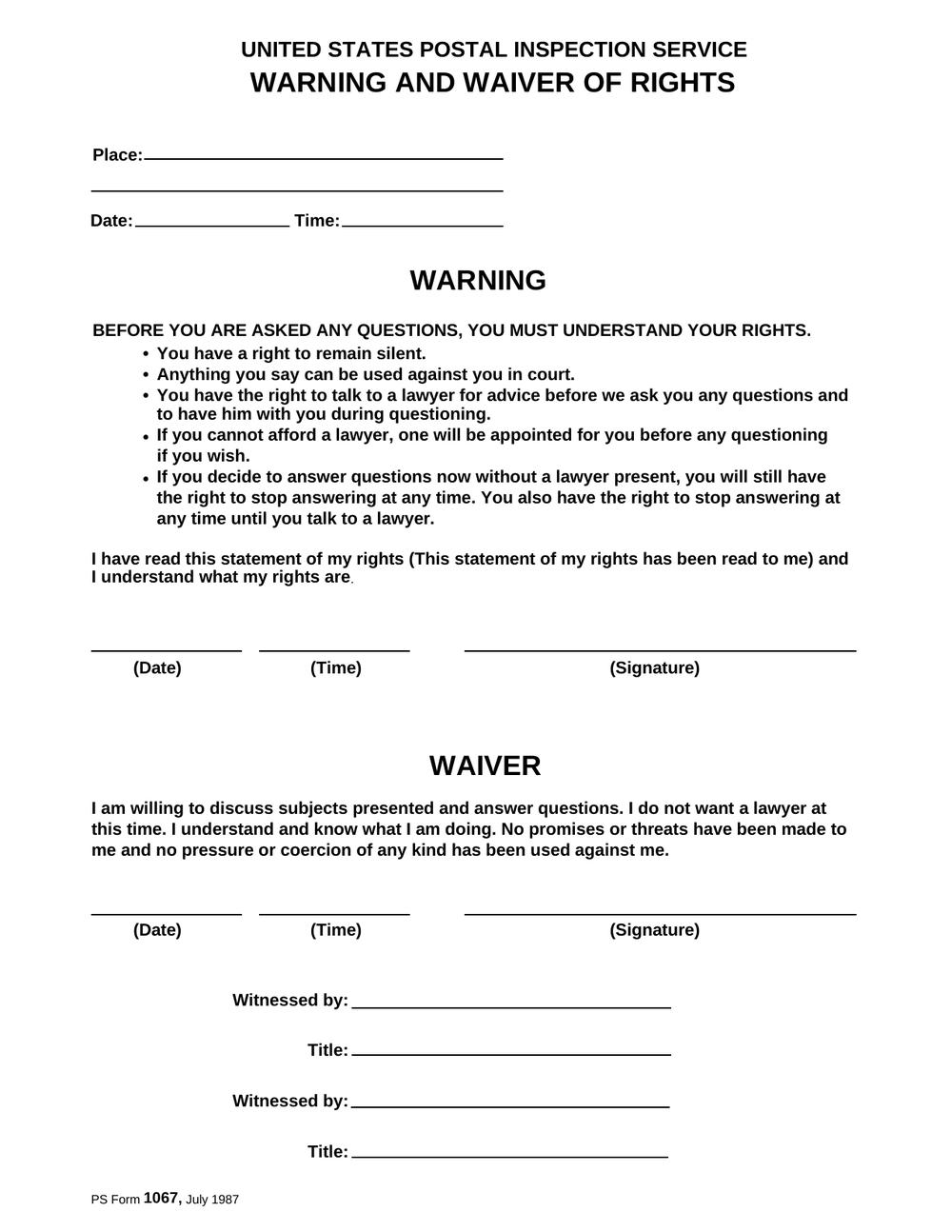
Miranda: right to remain silent and to an attorney. Kalkines: you must answer truthfully, but your answers can't be used against you criminally. Garrity: right to remain silent on anything that could implicate you in a crime. Do NOT sign PS Form 1067 (Warning and Waiver of Rights) without first consulting an attorney.
Stewards: up to 49 carriers is 1 steward; 50–99 is 2; 100–199 is 3; 200–499 is 5; 500 or more is 5 plus 1 more per 100 employees.
CCAs can serve as stewards.
Local issues — vacation bidding, job postings, overtime lists — are bargained locally through the LMOU (Article 30).
CCAs can grieve alleged discrimination and Rehabilitation Act violations (Article 2).
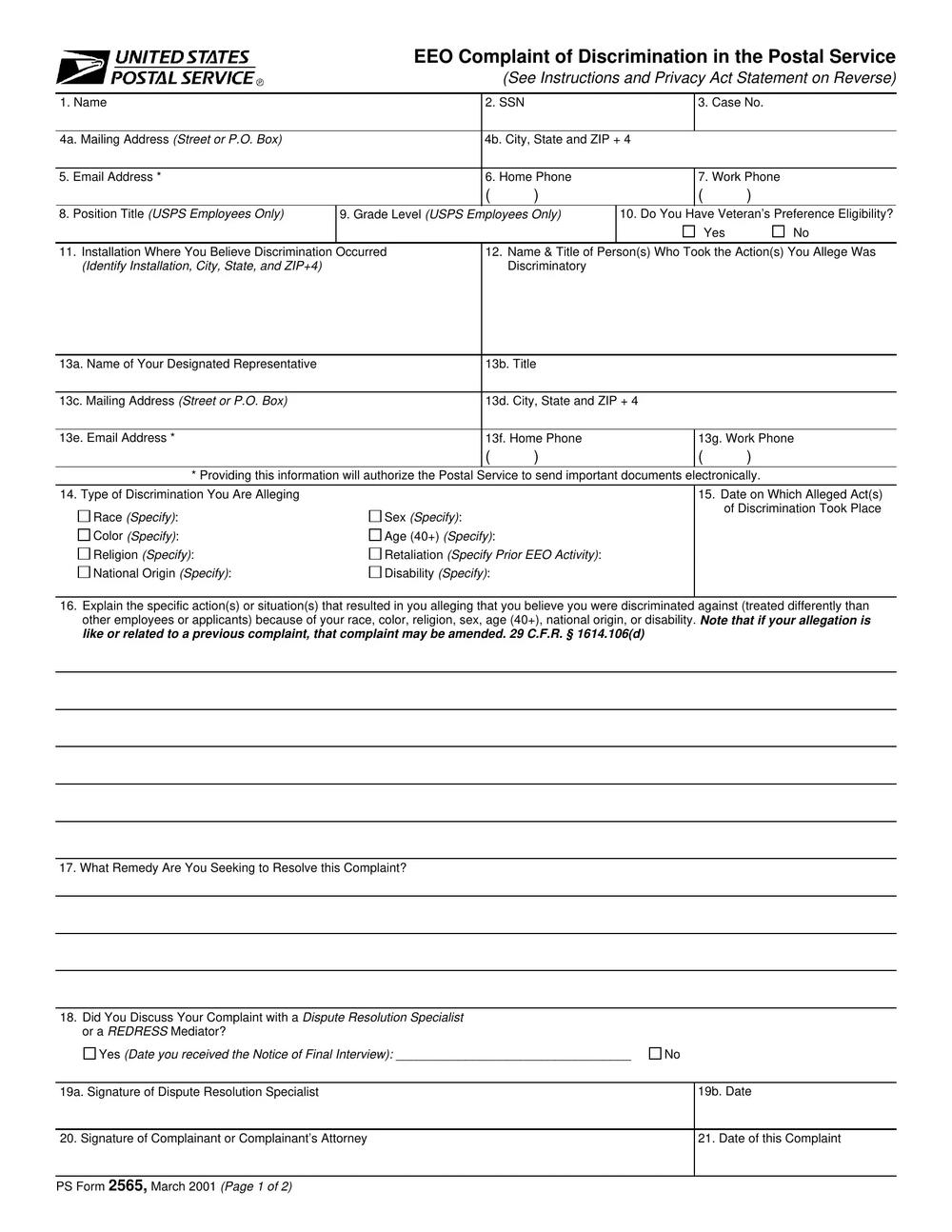
EEO complaints: file on PS Form 2565.
The formal complaint goes to NEEOISO, PO Box 21979, Tampa, FL 33622-1979, postmarked within 15 calendar days of receiving PS Form 2579 (Notice of Right to File). Or call 1-888-EEO-USPS (1-888-336-8777); TTY 888-325-2914.
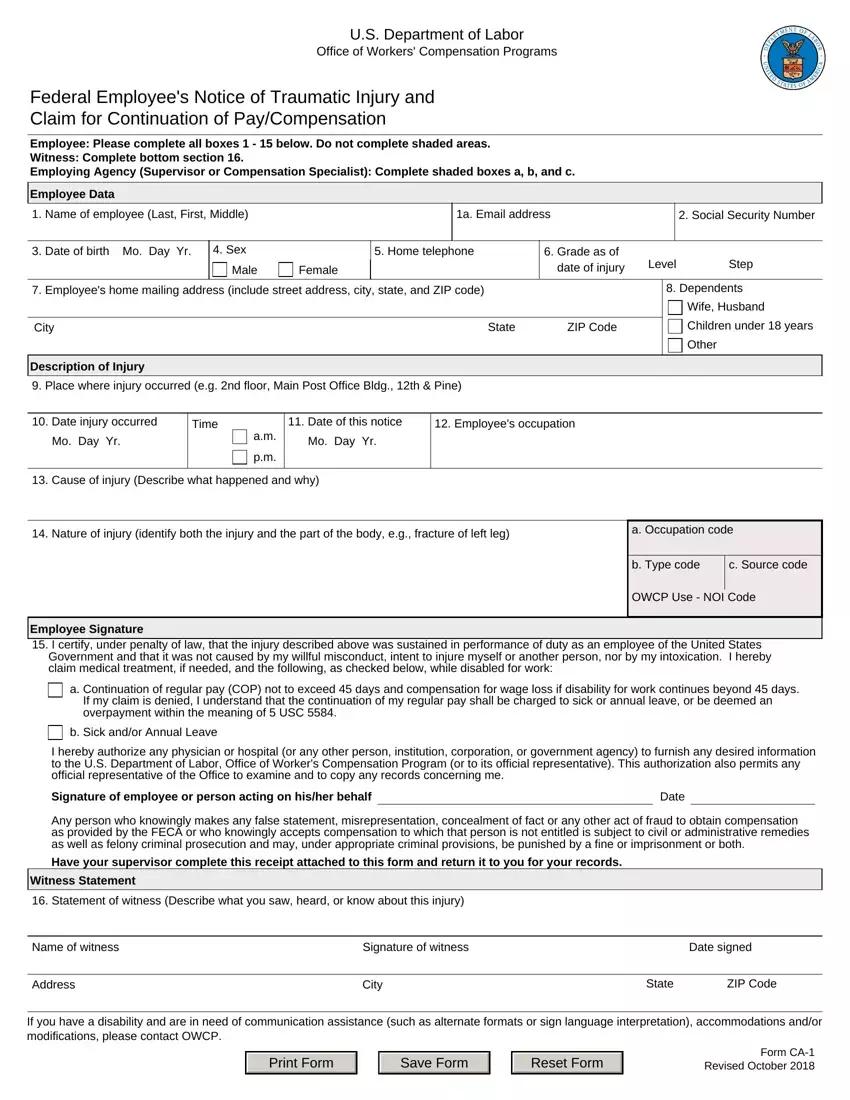
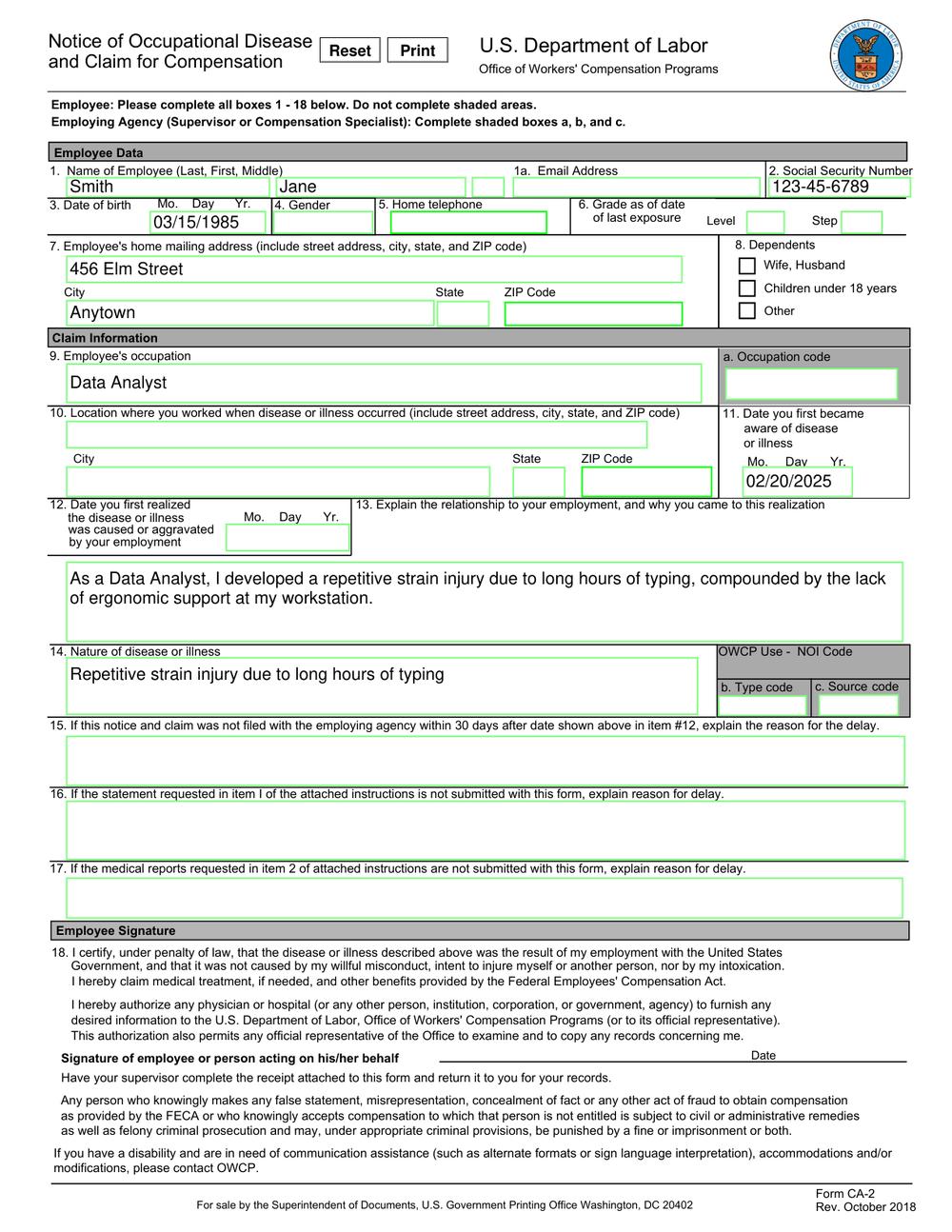
Injury on the job: file CA-1 for a traumatic injury, CA-2 for an occupational disease or illness that builds over time.
File through ECOMP (www.ecomp.dol.gov). Contact your steward immediately for OWCP help. You're covered by FECA from your very first day.
Report hazards on PS Form 1767.
If there's no corrective action during your tour, file a Formal Step A grievance within 14 days of notifying management.
CA-16 (Authorization for Examination and/or Treatment): request it if you're filing within one week of the injury.
USPS must provide it within 4 hours of your request, and it authorizes treatment for 60 days from the date of injury.
Continuation of Pay: for a CA-1 only, up to 45 calendar days of regular pay.
To qualify you must file the claim within 30 days of the injury, begin losing time within 45 days, and provide doctor-signed medical evidence within 10 days. The first 3 calendar days are waiting days. After that, wage loss is 2/3 of your pay with no dependents, 3/4 with one or more.
You have the right to choose your own doctor.
Do NOT hire private-sector companies that offer to help with your OWCP claim — branch officers, national business agents, and Regional Workers Compensation Assistants help members for free.
EAP is free and confidential — counseling for alcohol or drug abuse or any family or personal problem.
1-800-EAP4YOU or 1-800-327-4968. Voluntary EAP participation for alcohol or drug abuse is considered favorably in disciplinary proceedings.
- If you have a disability, USPS must reasonably accommodate you — ask your supervisor (Handbook EL-307).
Conversion to Career
- Conversion runs on relative standing in the installation: when USPS hires career carriers, the CCA with the most relative standing converts first.
Relative standing is your original CCA hire date in the installation.
Prior TE time (appointments after Sept 29, 2007) counts toward it; time on the 5-day breaks between TE terms doesn't. Ties are broken by order on the hiring list.
- CCA relative standing does NOT transfer to another installation (TE time does).
- Turning down a conversion offer does not cost you relative standing for future chances.
Layoffs go by inverse relative standing (least standing first).
Not grievable unless pretextual. A CCA separated for lack of work gets preference for reappointment if hiring resumes within 18 months.
Full-time openings are filled in order: (1) unassigned regulars or full-time flexibles in the same installation, then PTFs converting to full-time; (2) PTFs on the rolls on August 7, 2017 with an active transfer request; (3) CCA conversions in the same installation or transfer requests from other bargaining-unit employees.
(2023 MOU Re: Full-time Regular Opportunities.)
24-month PTF conversion: CCAs reaching 24 months of relative standing are converted to part-time flexible career status in their installation.
Declining it means you can't convert under that rule again, but you keep your relative standing and stay eligible for full-time regular conversion. Reassigning to another installation resets your relative standing clock — think twice before transferring.
See more
As of November 2025, conversion meant a pay bump of at least $3.00 an hour (up to $5.62 for a PTF on a T-6 opt).
Check the current pay chart, since rates move with COLAs and the contract.
On conversion, choose health and life insurance within 60 days of the conversion date.
The conversion date is the "enter on duty date" on your PS Form 50. After that, changes only during Open Season.
On conversion, sick leave starts at 4 hours per pay period, with no cap.
Sick leave counts as service time toward retirement. Annual leave by career service: 0–3 years, 4 hours per pay period (13 days a year); 3–15 years, 6 hours (20 days); 15+ years, 8 hours (26 days). Rollover is capped at 440 hours (55 days).
Unused annual leave is cashed out when a CCA converts to career, and at retirement.
Career carriers can sell back up to 40 hours of annual leave before the leave year starts, if they're at the carry-over ceiling and used fewer than 75 hours of sick leave the year before.
TSP after conversion: USPS matches your contribution dollar-for-dollar, up to 5% of pay.
The yearly contribution limit changes each year, so check the current figure.
Miscellaneous
Forms referenced on this page — what each one is and when to use it. Tap a picture to open it full size.
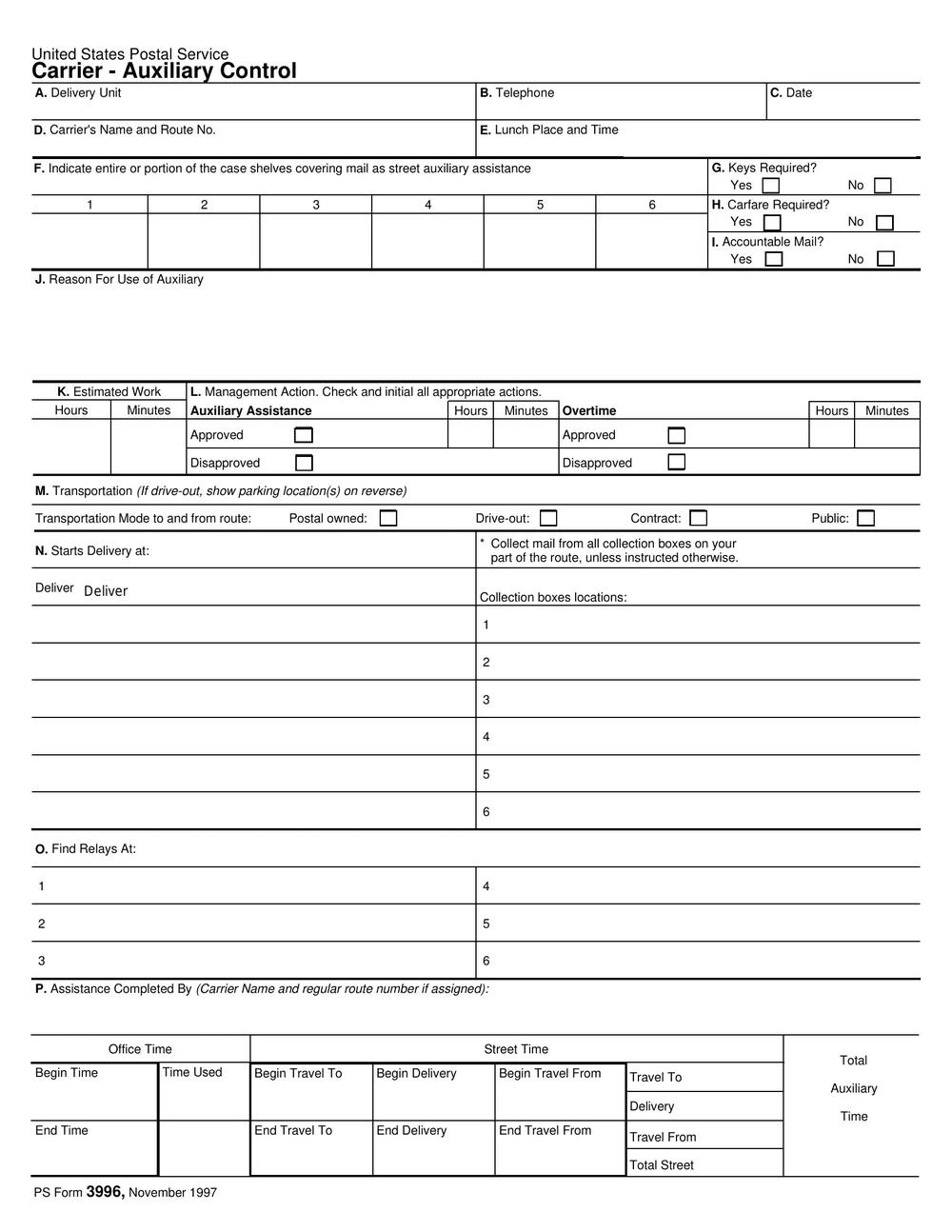 — File it when you can't finish your route in 8 hours. Be specific about why.
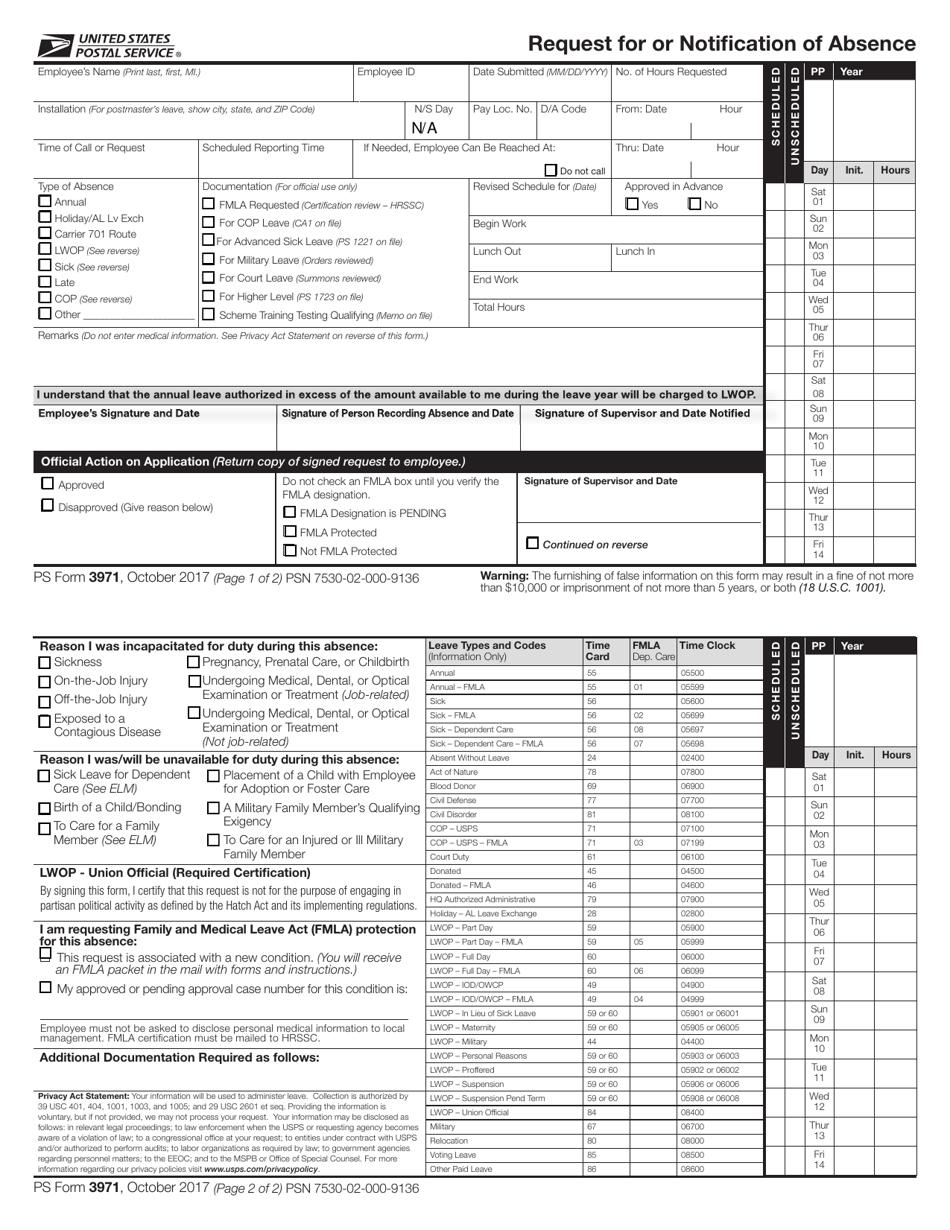 — All leave goes on this form — annual leave, holiday/AL exchange, Wounded Warriors Leave. Keep a copy.
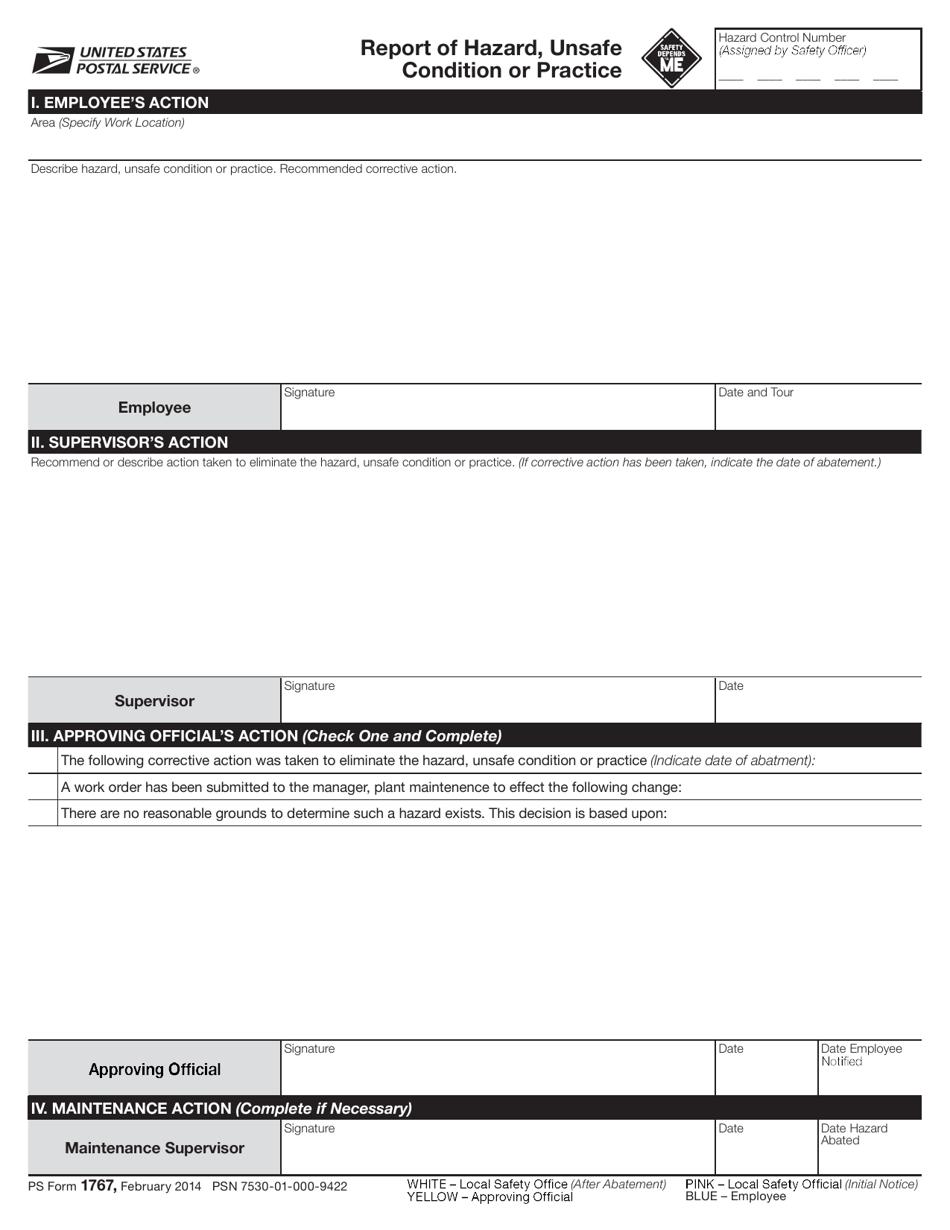 — Report any hazard or unsafe condition on your route or in the office.
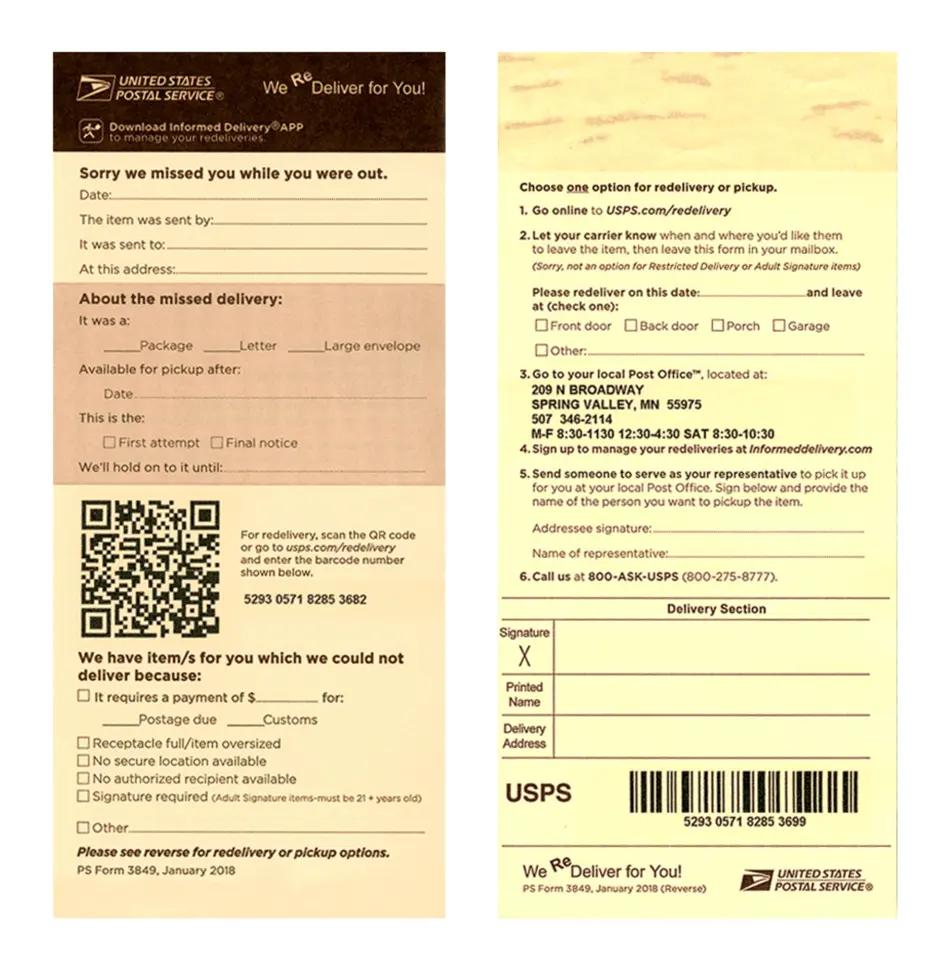 — The "Sorry we missed you" slip — leave it at the door when a package can't be delivered or needs a signature. The customer uses it to arrange redelivery or pick it up at the office.
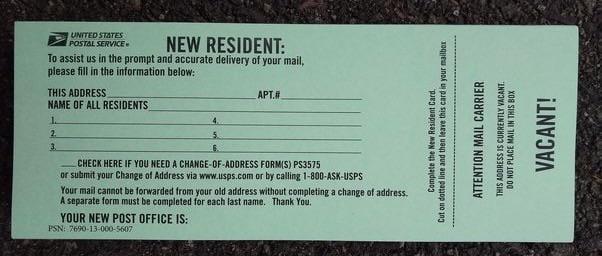 — The green card that marks an address as vacant — placed in the box when a residence is empty.
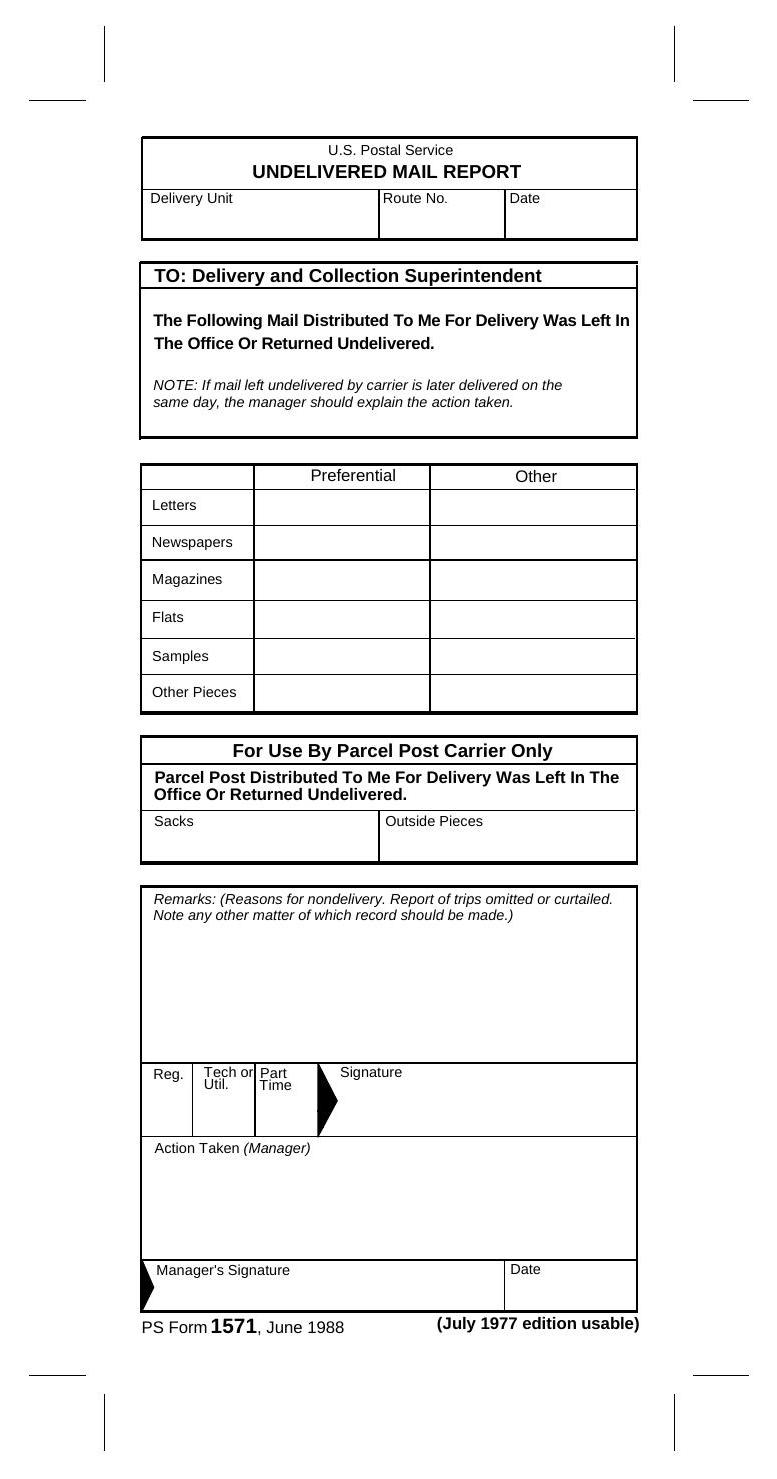 — Report mail that can't be delivered so the address can be corrected or the mail returned.
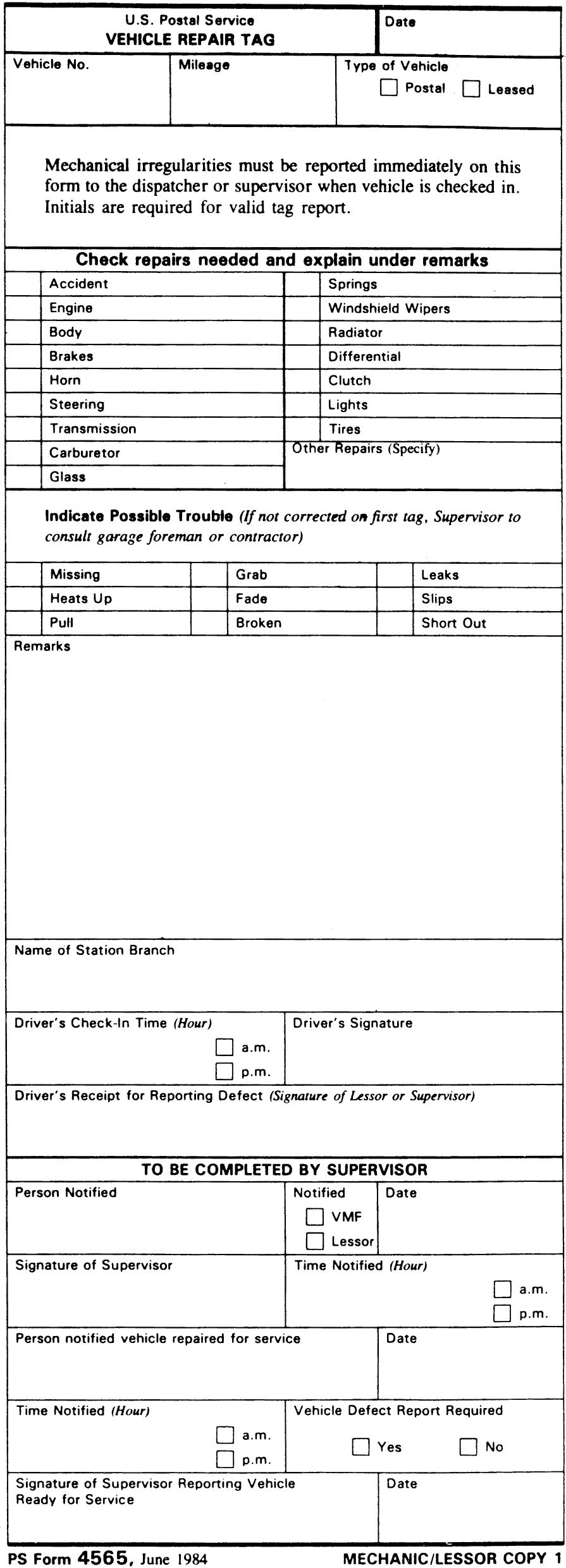 — Tag a vehicle that needs repair — check off what's wrong and hand it to your supervisor so the shop knows what to fix.
Sources
- NALC CCA Resource Guide — April 2016, the comprehensive guide. Built on the 2011 agreement, so dollar figures and some terms are dated.
- NALC New Member Resources — NALC's page for new members.
- CCA Survival Kit — NALC Branch 6000, November 2024. Day-to-day survival items for new CCAs.
- CCA's and Opting (Hold Downs) — NALC Branch 6000, October 2017, updated March 2021. How hold-downs work, including bumping.
- What to be Aware of When Being Converted from CCA to Career Employee — NALC Branch 6000, November 2025. Pay, leave, TSP, and insurance on conversion.
- CCA Tips & Training — NALC Branch 40, October 2016. Hours, lunch and breaks, vehicle safety.
- CCA Rights and Benefits — NALC guide excerpt (printed pp. 18–72), built on the 2019–2023 National Agreement with a March 11, 2023 pay table. Dollar figures are from that agreement — confirm current amounts with your steward. (File via NALC Branch 421.)
- New Employee Experience, Retention and Mentoring Program (NEERMP) — NALC/USPS joint announcement, July 2025.
- M-02010: NEERMP Questions & Answers — 2025. Schedule posting, non-scheduled days, and work-hour limits for new employees.
- NEERMP — The Postal Record — September 2025. The program explained: workhour limits, EIN and pay, mentoring, and what new carriers should expect.